
 By BullScreen Editorial Team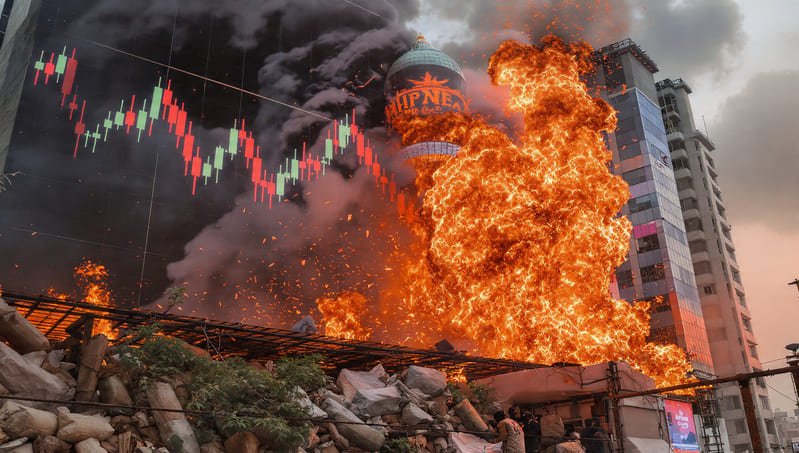
Indian equities opened the week on a sharply negative note, with benchmark indices witnessing intense selling pressure amid escalating tensions in West Asia and a spike in global crude oil prices.
The Nifty 50 slipped below the crucial 24,900 mark in early trade, while the BSE Sensex plunged over 1,000 points as investors reacted to global turmoil and rising energy risks.
At 11:04 AM, Nifty50 was trading at 24,862.75, down 316 points or 1.25%. The Sensex stood at 80,246.75, lower by 1,040 points or 1.28%.
The sharp fall comes against the backdrop of intensifying military conflict in the Middle East, triggering a surge in oil prices and rattling global markets. Brent crude briefly spiked as much as 13% before paring gains, as fears mounted over disruption of oil supplies through the Strait of Hormuz — a key global energy corridor.
On Monday, crude prices extended gains by over 8% to multi-month highs amid escalating attacks between Iran and Israel, including damage to tankers and supply routes.
Asian markets fell around 1.1%, while US and European equity index futures also traded lower, reflecting a broad-based global risk-off mood.
Analysts warn that sectors heavily dependent on crude derivatives may face near-term margin pressure. Oil marketing companies, paints, tyre manufacturers, aviation firms and chemical producers could see input costs rise if crude sustains at elevated levels.
Conversely, upstream oil producers such as Oil and Natural Gas Corporation and Oil India Limited may benefit from improved realisations. Defence stocks including Hindustan Aeronautics Limited and Bharat Electronics Limited could also see positive investor sentiment amid heightened geopolitical tensions.
Dr. VK Vijayakumar, Chief Investment Strategist at Geojit Investments Limited, noted that uncertainty surrounding the West Asian conflict will weigh on markets in the near term.
According to him, the primary market risk stems from a potential energy shock. A sharp 20% spike in crude is likely only if the Strait of Hormuz is formally closed, disrupting oil transport. As of now, there is no official confirmation of such a development.
He added that if Brent crude stabilises around $76, equity markets may remain weak but are unlikely to witness a severe crash.
“Experience tells us that panic selling during a crisis is the wrong strategy,” he said, highlighting that past geopolitical shocks — including the Covid crisis, the Russia-Ukraine war, and the Gaza conflict — had limited long-term market impact six months down the line.
However, he cautioned that wars can spring unexpected surprises, and investors should remain vigilant.
Adding to the negative sentiment, foreign portfolio investors (FPIs) were net sellers of Indian equities worth ₹7,536 crore on Friday. Domestic institutional investors (DIIs) cushioned the fall to some extent, buying shares worth ₹12,293 crore on a net basis.
Market experts suggest that volatility-driven weakness could offer staggered buying opportunities in high-quality domestic consumption themes such as banking, automobiles, capital goods and defence.
With geopolitical developments dictating near-term direction, traders are likely to remain cautious, keeping a close watch on crude prices and global diplomatic signals.